
A World Unsettled: How Global Risks Shifted from Pandemic Shock to Geopolitical Strain Pure Capital, 2026-02-24
PDF Article here
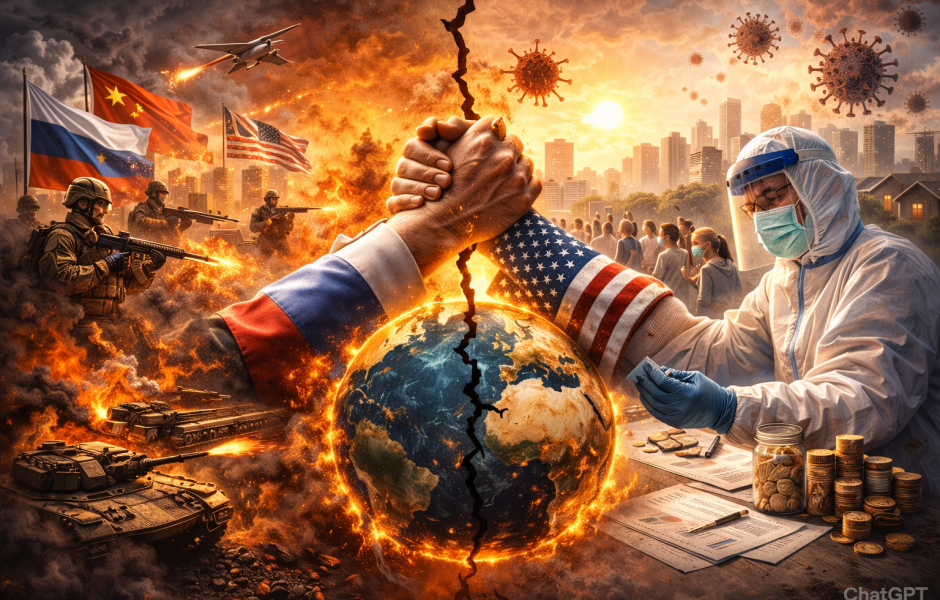
The last three editions of the World Economic Forum’s Global Risks Report chart a rapid shift from a world preoccupied with pandemic aftershocks and inflation to one increasingly defined by geopolitical confrontation, structural environmental stress and system-level technology risks. Taken together, the 2024, 2025 and 2026 reports portray a risk landscape that is not only deteriorating, but also becoming more tightly coupled across domains.
FROM POLYCRISIS TO FRAGMENTATION
The 2024 report already described a world “at a turning point”, with lingering effects from COVID-19, the war in Ukraine and cost-of-living pressures. Short-term risk perceptions were dominated by extreme weather, AI-driven mis- and disinformation, and societal and political polarisation, with economic worries like inflation and downturn re-entering the two-year top-10 list. Respondents expected the global outlook to move from “unsettled” to clearly “turbulent” over the decade, with nearly two-thirds anticipating a stormy or turbulent world by 2034. By 2025, the tone darkens further. The report’s subtitle, “A world of growing divisions”, reflects a marked deterioration across geopolitical, environmental and societal dimensions. State-based armed conflict becomes the top current risk for 2025, a sharp rise from its ranking two years earlier, while geoeconomic confrontation moves into the top three short-term concerns. At the same time, inequality is identified as the most central node in the risk-interconnection network, linking economic hardship, political polarisation and erosion of rights. The 2026 report, “The Age of Competition”, crystallises this trajectory: competition—between states, blocs, firms and technologies—emerges as the defining organising principle of the decade. Geoeconomic confrontation overtakes all other risks as the most likely source of a global crisis in 2026, closely followed by state-based conflict, while economic downturn and technology-related threats return to the top of executives’ and experts’ agendas.
SHIFTING RISK RANKINGS: WHAT CHANGED?
Several structural shifts stand out across the three editions.
➢ Geopolitics moves from background to foreground.
In 2024, interstate conflict was a serious but not dominant short-term concern; by 2025 it is ranked the single most likely trigger of a global crisis, and by 2026 geoeconomic confrontation is perceived as the primary near-term shock, with conflict a close second.
➢ Environmental risks move from “future” to “present”
Extreme weather is already the top one-year risk in 2024, selected by two-thirds of respondents for 2024. Over the 10-year horizon, environmental risks—extreme weather, critical changes to Earth systems, biodiversity loss and natural resource shortages—dominate the rankings in both 2024 and 2025, and remain the top-five long-term risks in 2026.
➢ Economic risks fade in perception, then return.
In 2024, inflation and economic downturn re-enter the two-year top 10 after the post-pandemic cost-of-living shock. By 2025, those concerns have subsided in relative terms: inflation and recession drop out of the two-year top 10, even though inequality, debt and crime are recognised as key drivers of fragility. In 2026, however, economic risks re-emerge: economic downturn rises strongly in the short-term ranking, and asset-price vulnerabilities and debt are highlighted as critical medium-term fault lines.
➢ Technology risks evolve from disinformation to systemic AI.
In 2024 and 2025, mis- and disinformation is the top two-year risk, linked tightly to polarisation, censorship and erosion of rights. Cyber risk remains consistently high. By 2025 and especially 2026, adverse outcomes of AI technologies move rapidly up the 10-year rankings, signalling growing concern that AI could shape labour markets, security and the information environment in structurally destabilising ways.
CONVERGING STRUCTURAL FORCES
All three reports frame these changing rankings through four structural forces: technological acceleration, geostrategic shifts, climate change and demographic bifurcation. Over 2024–2026, these forces cease to be background trends and start to define the risk architecture:
➢ Technological acceleration underpins the rise of AI-related risks, cyber-enabled crime, and quantum-era security concerns, while also promising productivity gains and medical advances.
➢ Geostrategic shifts are visible in the expectation of a multipolar or fragmented order by mid-2030s, with middle and great powers contesting regional rules rather than reinforcing a single rules-based system.
➢ Climate change drives both acute hazards (extreme weather, floods, heatwaves) and chronic stresses (water scarcity, biodiversity loss, pollution), which in turn feed migration, inequality and conflict.
➢ Demographic bifurcation splits the world into super-ageing societies facing pension and care crises and younger societies grappling with unemployment and governance pressures.
IMPLICATIONS FOR RISK MANAGEMENT
For boards, regulators and policymakers, the main lesson from the 2024–2026 sequence is that risks are becoming less siloed and more path-dependent. Short-term shocks—whether in trade, finance, elections or climate—are increasingly likely to cascade across systems. Strategic responses therefore need to:
➢ Integrate geopolitical and geoeconomic scenarios into core business and policy planning, not treat them as exogenous shocks.
➢ Treat environmental risks as current balance-sheet issues, not distant sustainability concerns, given their position at the top of 10-year rankings in all three reports.
➢ Build social resilience—through inclusive growth, social protection and trust-building—as a precondition for managing technological and climate transitions.
➢ Develop coherent governance for AI and emerging technologies that addresses both near-term information disorders and longer-term systemic risks.
In that sense, the evolution from 2024 to 2026 is less a series of disconnected annual rankings and more a continuous warning: without coordinated action, the world moves from polycrisis to entrenched fragmentation, in which environmental ceilings and technological uncertainties collide with geopolitical rivalry and social fracture.
Disclaimer :
The above content was produced and is distributed by Pure Capital SA. It is provided for informational purposes only and aims to present the managementactivities of Pure Capital SA (hereinafter "Pure Capital") and to provide information about its investment strategies. The information and data (including textand photographs) contained in this document are protected by copyright, and any reproduction or distribution thereof to third parties, in whole or in part,without the prior consent of Pure Capital, is prohibited.Pure Capital reserves the right, at any time, to modify or change the data contained in this document without prior notice.This document should in no way be construed as an offer to buy or sell any financial instrument or as any form of solicitation or inducement to buy or sellfinancial or investment instruments. All information published herein is provided for informational purposes only and does not constitute investment advice.Nevertheless, no guarantee can be given as to its accuracy or completeness. This information has not been prepared in accordance with legal requirementspromoting independent investment research and should therefore be considered marketing material. Although this content is not subject to any restrictionson its use prior to its dissemination (e.g., for executing orders), Pure Capital does not seek to profit from it.For further details concerning the investment products, the official sales documents (the Key Investor Information Document, the prospectus, the half-yearlyreport and the annual report) are available free of charge upon request from Pure Capital SA (hereinafter “Pure Capital”) (tel.: +352 26 39 86) or by consultingthe website www.purecapital.eu.The information contained in this document is provided in good faith and does not constitute a commitment on the part of Pure Capital.There can be no guarantee that investment objectives will be achieved. Past performance is not a reliable indicator of future results. Performance may varyover time. The net asset value of the portfolio depends on market trends. Therefore, all investment funds are subject to market fluctuations, and investors mayreceive less than their initial investment.Annual custody fees, or deposit charges, may be levied by your account holder. These vary from one institution to another. Please inquire with them for details.This document is provided to you on the condition that it will not constitute a primary basis for any investments. Any investment should be the resultof a fully informed and considered decision.