
THE LONG-AWAITED CORRECTION IS TAKING ITS TIME Dominique Marchese, 2025-12-02
Key words: AI, markets, FED, climat.
Version PDF
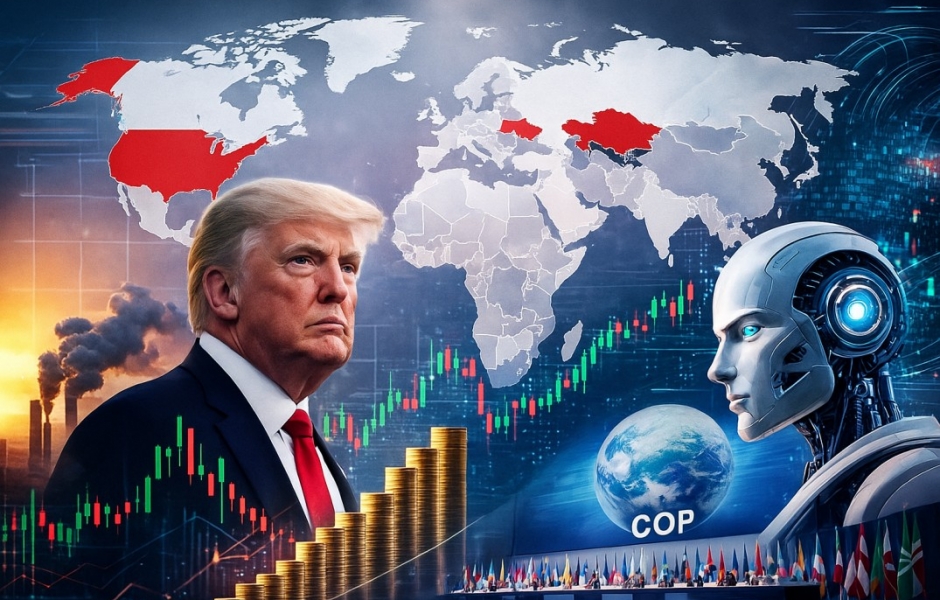
Hopes for monetary easing from the US Federal Reserve, expectations of an end to hostilities in Ukraine, and a degree of rationality reflected in the performance of technology sector indices and individual stocks (concerns about a potential artificial intelligence investment bubble) seem to be pushing the prospect of a sharp market correction further away. Profit-taking during November was ultimately modest. Financial markets showed very limited interest in the latest COP (Conference of the Parties) on combating climate change.
Markets remain very strong overall.
The highly publicized fears of an AI bubble bursting have the effect of making investors more cautious and selective, which effectively reduces the risk of a sharp drop in indices followed by a prolonged bear market. Portfolio managers, more sensitive to the strength of balance sheets and the sustainability of cash flows, are reducing their exposure to the riskiest companies due to the problems of circularity and inbreeding within the AI ecosystem (financing by their clients' suppliers, cross-shareholdings, the weight of off-balance-sheet financial commitments), to lower value-added businesses (data center operators, for example), and even to the world leader Nvidia , designer of GPU chips for AI, whose competitive position is being challenged following Alphabet's recent successes with its new Gemini 3 language model, trained at lower cost using its own TPU chips. The positions of AI leaders are far from fixed, including in the architectures of generative models, which is excellent news for AI deployment costs and its widespread adoption throughout the economy. These periods of consolidation in technology indices, accompanied by sector rotations and arbitrage, are ultimately quite healthy. They demonstrate that markets are actually far from experiencing widespread, irrational exuberance, despite some exaggerations. The AI revolution is still underway.
Markets were also supported by the prospect of continued monetary easing by the US Federal Reserve (Fed), despite the headache of the interruption in official economic data during the government shutdown . Nevertheless, the limited analyses available point more towards a weakening labor market, which investors interpret as "good news" regarding the Fed's upcoming monetary policy decisions. In Europe, hopes for peace in Ukraine, despite their fragility, supported cyclical sectors related to materials and construction.
Some comments on the last COP, which was scorned by the markets
Of course, the COP (Conference of the Parties) in Belém was a failure. In a world that has become conflictual, it would have been naive to hope for a collective awakening. No roadmap has been adopted for phasing out fossil fuels, and China has managed to implicitly condemn the European Union's (EU) policy of carbon border taxes. The UN seems to have definitively lost control of the climate change issue. The goal of limiting the rise in average temperatures to 2°C above pre-industrial levels, when they are on the verge of crossing the symbolic threshold of 1.5°C, unsuccessfully defended by the 2015 Paris COP21, has undoubtedly become unattainable. Based on current commitments, average global warming could reach 2.5°C to 2.8°C by the end of the century—a consensus that is perhaps too optimistic—promising a runaway increase in natural disasters for human civilization. Are political leaders demonstrating sufficient transparency and honesty on this issue? In fact, despite the efforts made, global consumption of primary fossil fuels has increased by 50% since the Kyoto Protocol of 1997. They still represented 82% of the global primary energy mix in 2022, a very modest decrease of 5 percentage points. Current energy transition efforts represent just over 2% of global gross domestic product (GDP) per year, whereas investment would need to be at least six times greater annually by 2050, and undoubtedly much more when factoring in the inevitable budget overruns (" Halfway "). Between Kyoto and 2050: Zero Carbon Is a Highly Unlikely ( Outcome , Vaclav Smil , Fraser Institute, 2024, Arpa editions , 2025 for the French translation). In short, despite the progress made by the COPs, it won't be enough. If rich countries were to truly shoulder the burden that the rest of the world cannot afford, they would spend 15 to 20% of their GDP each year, a simply absurd scenario that would cause the collapse of our democratic societies. Vaclav Smil , a geographer specializing in these issues, estimates the cumulative investment need at between 400 and 460 trillion dollars by 2050, or about 3.5 to 4 times the current global GDP! Has no political leader done the math? The 300 billion dollars in aid per year promised to developing countries, resources wrested with great difficulty by the COP, are clearly paltry compared to the challenges.
As an illustration, decentralized and intermittent solar and wind power generation will require upgrading or adding 80 million kilometers of transmission networks by 2040—the size of the current global grid!—which implies intensive use of materials. The cost of solar and wind power considered in public policy must include investments in grids, storage, and backup systems. One megawatt produced by a gas-fired power plant requires at most 30 tons of materials during its construction, compared to 500 tons for a wind turbine (cement, steel, copper, carbon fibers, etc.). Converting the steel, ammonia (necessary for fertilizer production), and glass industries, as well as transportation and heating, to green hydrogen would mean dedicating 86% of electricity consumption in 2022 to electrolysis (Vaclav Smil ). One final, particularly telling example: to achieve carbon neutrality by 2050, the cumulative demand for copper would reach 600 million tons, requiring the processing of 100 billion tons of earth and rock (low in copper content), twice the total annual amount of materials extracted from the Earth, including biomass and hydrocarbons! Imagine the environmental impacts and associated costs! Has any politician seriously considered this minor issue?
The issues raised by the blatant failure of the last COP are numerous. First and foremost is the need to implement large-scale policies to adapt our civilization to climate change, which has become inevitable despite current efforts. The expected economic upheavals are obviously enormous and still poorly understood. The resources, woefully inadequate, have so far been focused almost exclusively on the energy transition alone. The EU, which hypocritically seeks to amend its Green Deal and dismantle its Kafkaesque regulations, shamelessly expresses its satisfaction with the decrease in CO2 emissions in Europe—a decrease more than offset, however, by the rest of the world—and which stems primarily from the weakening, or even destruction, of entire sectors of its industry in order to transfer production to countries with high fossil fuel consumption. In Europe, mining law and environmental regulations make the rapid opening of a production site for minerals or rare earths essential to energy transition technologies virtually impossible. To date, the Solvay chemical group, which operates the only rare earth refining plant in Europe (La Rochelle, France), has signed contracts only with American clients, and no agreements with European manufacturers who continue to source their supplies from China—ironic, isn't it? This is more than symptomatic of the absurd complexity weighing on the EU's competitiveness, as described in detail in the Draghi report. The last COP raises the question of the true and exorbitant cost of the energy transition. While our democracies suffer from a glaring lack of financial resources, they have nevertheless, against all logic, decided to pursue several objectives at once: sovereign infrastructure (semiconductors, AI infrastructure, etc.), rearmament, energy transition, social policies (aging population, etc.). Synonymous with a scattershot approach to very limited budgets, this policy, widely deployed in Europe, is doomed to failure. This ultimately raises the following crucial question for investors: the record level of public debt worldwide, its necessary sustainability, and the colossal investment needs require a generalized decrease in real interest rates (after inflation); what do central banks think about this, and more specifically the European Central Bank, committed solely to defending price stability, yet very enthusiastic when it comes to promoting the channeling of funds towards "green" investments?
While financial markets seem to be focusing their attention only on the Federal Reserve, Donald Trump, war-torn Europe and the possibility of an AI bubble, investors can rightly be surprised by the lack of interest shown towards the last COP and the consequences of this collective failure.
Conclusion
Financial markets are preparing to close out a tumultuous 2025 since Donald Trump's return to the White House. They are expected to fare much better than the most pessimistic investors feared at the beginning of the year. Apart from the days immediately following the extravagant "Liberation Day" (Donald Trump's announcement of reciprocal tariffs on April 2nd), their behavior, and in particular their low volatility, does not reflect the general impression of chaos that prevailed globally for a long time, at least until the easing of trade tensions between the United States and its main partners.
Investors seem to recognize the remarkable adaptability of the private sector and businesses, including European ones, which have integrated geopolitical risks into their business management and investment decisions. Since the 2008 subprime mortgage crisis , the most glaring error made by bearish investors has been underestimating this adaptability and resilience in the face of numerous political upheavals and multiple financial crises. While climate issues remain a pressing concern, the AI revolution will further strengthen this resilience and flexibility in a geopolitical environment far more conflictual than in the past.