
THE MONTH OF JANUARY SETS THE TONE Dominique Marchese, 2026-02-04
Key words: Volatility, Geopolitics, Artificial Intelligence, Diversification.
Version PDF
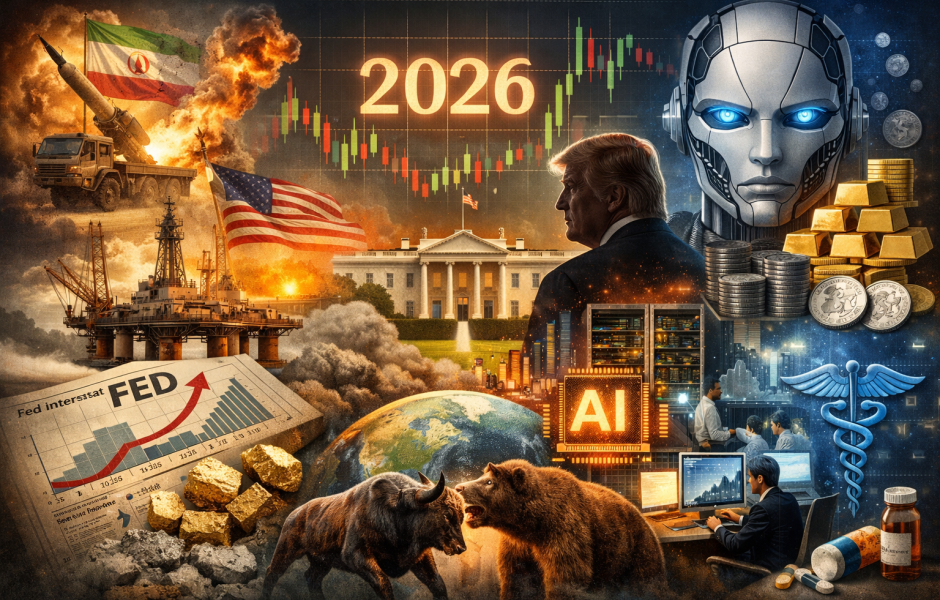
Investors were certainly not bored during the first month of the year! Geopolitical tensions (Iran, Venezuela, Greenland…), the strong start of stock market indices, and heightened volatility in precious metals, amid uncertainties surrounding the independence of the Federal Reserve (Fed) and the appointment of its new chairman, provided a backdrop, while the first quarterly results and forecasts for 2026 led to sharp portfolio adjustments, particularly among leaders in technology and artificial intelligence (AI). Given the political agendas and the high level of uncertainty, the rest of the year is expected to be just as dramatic.
The excellent performance of stock market indices
The robust health of stock markets in such a climate of uncertainty may seem surprising to many outside observers bombarded by the media. Global stock markets appear to have become perfectly accustomed to the often-perceived unrestrained activism of Donald Trump, who relentlessly pursues the political agenda for which he was elected, and to a geopolitical context that has become decidedly conflictual, even among former allies. Incidentally, the White House's ambitions regarding Greenland fit perfectly within the historical trajectory of the United States, which has been acquiring territories from European nations for over two centuries. We thus recall the purchase of Louisiana from France in 1803 – for a sum considered very modest today –, of Florida from Spain in 1819, followed by the acquisition in 1848 of important territories in Mexico which became independent in 1821, the purchase of Alaska from Russia in 1867, and more recently the acquisition of the Philippines from Spain in 1898, which would not become independent until 1946. At the end of the Second World War, when the United States understood all the danger that the Soviet Union would represent for the free world, its president Harry Truman had already, without success, proposed to buy Greenland from Denmark. This list, while not exhaustive, should be considered in conjunction with the now-famous Monroe Doctrine (named after the 5th President of the United States, James Monroe, from 1817 to 1825), which denied the countries of Old World Europe the right to interfere in the affairs of the American continent, from Cape Horn to the northernmost tip of the Americas, under penalty of sanctions, including military ones. Donald Trump, in search of land rich in hydrocarbons, industrial minerals, and rare earth elements, and who judges, not without reason, Europeans incapable of defending a frozen land against the neo-imperial ambitions of Russia and China, is decidedly a figure of the 19th century … One can understand, with a little indulgence, the extreme difficulty experienced by Europeans in managing this power struggle, they who, after the end of the Cold War, discarded the concepts of nation, border, and patriotism—ideas since then considered, at best, conservative, at worst, repugnant. To conclude on this subject, let's not forget that European institutions were designed to manage a free trade area and promote trade flows with the rest of the world – the EU has, in fact, recently achieved some successes with Mercosur and the trade agreement with India. It's not unusual to see the Commission and the Council of the EU flounder when it comes to dealing with issues outside the mandate given to them by the European treaties. Obviously, the Americans, Russians, and Chinese are perfectly aware of this.
But the reasons that led us to express a positive view on equities haven't actually changed one bit since the beginning of the year. Despite this political and media circus, culminating in the Davos Forum, the global economy is doing rather well. Leading indicators are trending positively. The policy mix (the combination of fiscal programs and monetary policies) is favorable to economic activity. Even Europe seems to be gradually emerging from its torpor, with credit volumes to the private sector slowly picking up and the first encouraging signs observed in Germany. Accustomed to Donald Trump's dramatic gestures, his constant threats of tariffs to force his counterparts to back down, and the now-permanent international tensions, investors don't want to leave the dance floor and miss the rally, especially since the consensus for earnings growth in 2026 is around 14 to 15%, both in the United States and in Europe.
Only precious metals reflected investors' concerns about the dollar and the independence of the US central bank. Donald Trump's nomination of Kevin Warsh as Fed chairman, replacing Jerome Powell next May—an economist considered rather moderate, even a proponent of monetary orthodoxy (see his criticisms of financial bubbles caused by the excessive use of unconventional policies and the central bank's balance sheet)—nonetheless brought sudden reassurance to the markets and, in turn, triggered a sharp correction in gold and silver prices during the last trading session of January. Donald Trump seems to have clearly understood the message of "liberation day" (the sharp correction in financial markets and the alarming rise in federal debt yields last April, the infamous " sell America trade "). Investors are grateful to him for it.
The first lessons to be learned from the results season
The earnings season for listed companies is in full swing, and it's already proving highly informative. Here, we focus on the technology sector, as major stock market indices are heavily concentrated in companies exposed to AI. The technology and communications sectors represent approximately 35% of the main global index, but the weight of the AI ecosystem is much greater (data center equipment manufacturers, energy providers, etc.). The question of a potential AI investment bubble and the potential for business models to be weakened by new entrants has clearly not disappeared, as evidenced by the sometimes-violent stock market reactions to the results published for the fourth quarter of 2025 and the initial forecasts provided for the current fiscal year. The semiconductor sector, which accounts for between 8% and 10% of major stock market indices, has so far performed best. Equipment manufacturers report strong demand from their customers, particularly for memory chips, which are very resource-intensive for AI. European players such as ASML and ASM International are benefiting significantly. Prices for these chips are rising sharply due to a severe shortage of capacity. The entire value chain is benefiting from this powerful cycle, which is expected to last several quarters. The only downside is that consumer electronics prices are expected to climb in the coming months, which is less than ideal news for consumers and manufacturers of mobile phones, personal computers, and other electronic devices, who could face squeezed profit margins and lower end-user demand.
Cloud leaders (hyperscalers), AI companies, IT services firms, and software companies. Questions about disruptive technologies and their impact on monopoly or near-monopoly positions remain. The software industry has suffered on the stock market since the beginning of the year. The significant deflation of valuation multiples over the past 18-24 months continues. We have seen an average share price decline of over 20% since the beginning of the year for many leaders such as Salesforce, Adobe, and SAP. Accenture, a global player in IT services, has lost approximately 10%. While AI accelerates the development of IT applications (particularly through vibe coding), investors fear significant pressure on prices and margins for companies in the sector. End users will undoubtedly demand the lion's share of the productivity gains generated by AI, much like when IT service companies deployed their offshoring strategies in the 2010s (relocating part of their operations, particularly to India). Furthermore, AI allows new entrants to offer software solutions at lower cost. The good news is that fierce competition within the sector will lead to a faster diffusion of AI throughout the economy (a proliferation of use cases, accelerated deployment of AI agents, and increased productivity gains).
Among the leading cloud hyperscalers, we note Microsoft's sharp stock market decline, despite solid results that nevertheless failed to reassure investors about potential disappointment regarding the returns on the enormous investments made in AI—a topic of concern for many players. We eagerly await the results from Amazon.com and Alphabet! Meanwhile, Meta Platforms impressed the markets with its revenue growth in digital advertising.
The fact that the highly valued technology sector is showing clear signs of fragility and experiencing significant divergences in stock market performance is excellent news for active investors. The observed volatility raises the issue of sometimes extreme valuations that leave no room for disappointment. The overconcentration of major stock market indices in technology leaders and the overwhelming influence of the "Big Seven" (Alphabet, Amazon.com, Apple, Microsoft, Meta Platforms, Nvidia, Tesla), along with a few other giants, argues for greater diversification towards less valued sectors that will benefit from the productivity gains generated by AI. The healthcare sector is a prime example; it is not the only one. It seems that relying solely on a global index or a major technology index through an index fund as an investment strategy is no longer sufficient to generate returns.
Conclusion
January sets the tone for the rest of the year. Investors should expect continued anxiety in geopolitical news – although we hope that the approach of the US midterm elections (November 2026) will encourage the White House to exercise a little more restraint – increased volatility, and sudden market reversals that will have the advantage of offering new opportunities at bargain prices. Diversification, both geographical and sectoral, will be key to performance in 2026. We believe that passive portfolio management strategies, indexed to major indices and indifferent to valuation issues, are the most vulnerable to the inevitable shocks to come. For balanced portfolios between equities and fixed income, we reiterate our advice to exercise caution in the bond allocation, as risk premiums for lower-rated issuers remain at historically very low levels.